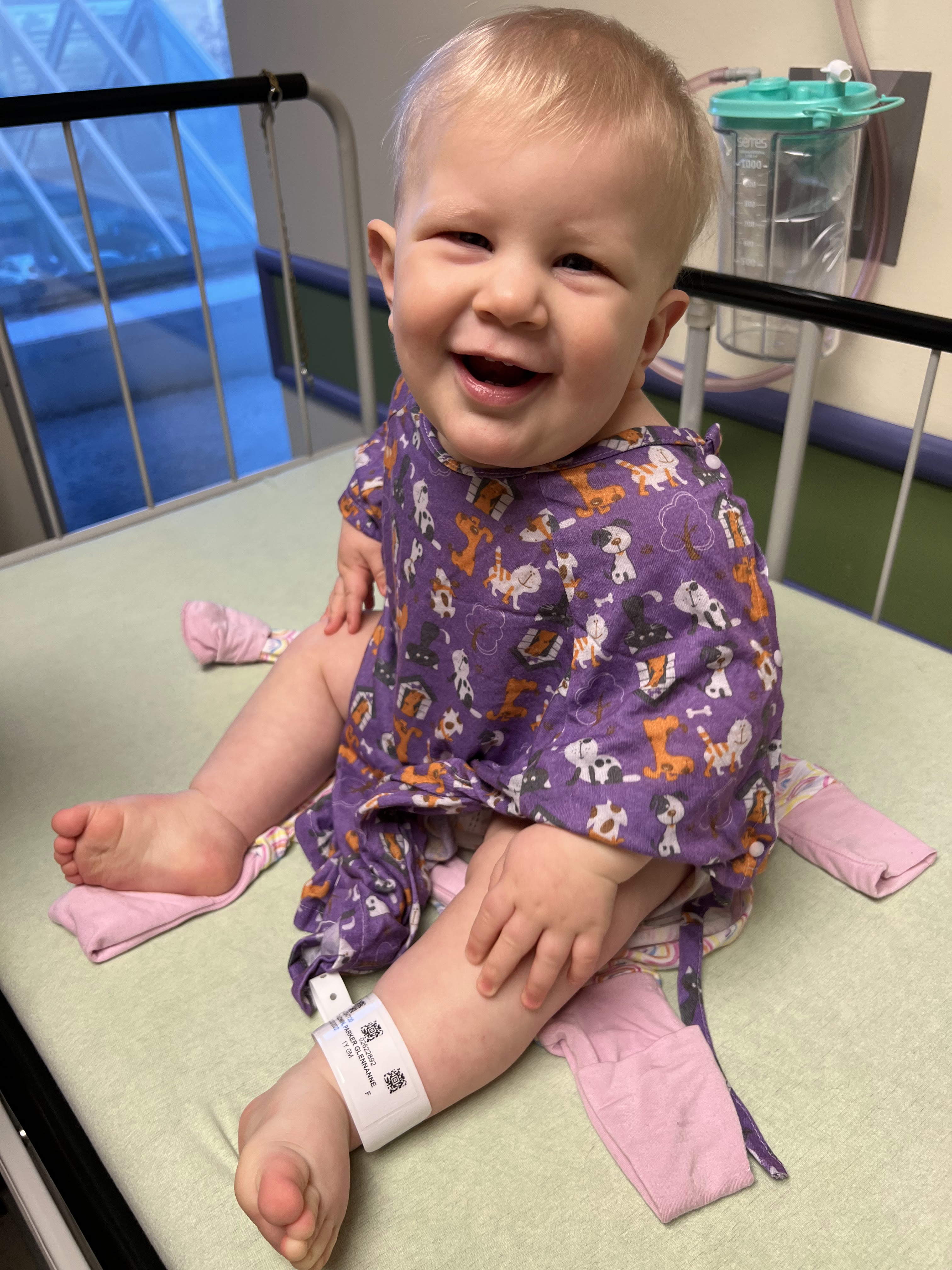
Following the strabismus surgery, Parker was scheduled to have an examination under anesthesia (EUA) in which a retinal ophthalmologist from Children’s Mercy Hospital would look for Familial Exudative vitreoretinopathy, or FEVR. Ignore the “Familial” part–while largely hereditary, this condition would be a result of Parker’s CTNNB1 disorder, which is not hereditary. FEVR is the result of reduced blood supply to the retina, which is the light-sensitive portion of your eye that converts that light into data for the brain to “see.” The lack of blood flow causes the body to seek alternative sources, but that process is flawed and the eye will literally be pulled away from the optic nerve, severing the retina and causing blindness. While not universal in people with CTNNB1 disorder, it is somewhat common. For her examination, Parker was put under anesthesia and a contrast dye was introduced into her bloodstream which would then allow the ophthalmologist to see the blood flow and if there were signs of FEVR, cauterize the under-performing vessels with a laser, which then would allow other vessels to take over in a way that would not cause retinopathy (the retinal detachment).

Our hope was, of course, that Parker would be one of the many cases of CTNNB1 disorder where the person would not have FEVR, but this turned out to be not the case. Early stages of FEVR were found in both eyes, and the laser treatment was used. The good news, perhaps the best news of the entire process, was that most children with FEVR are only diagnosed after experiencing permanent vision loss. Because of Parker’s genetic diagnosis, the FEVR was caught in the very early stages and could be treated then.
But as I said, that was the good news. The not-so-good news is that the examination also showed two other problems, both in Parker’s right eye, which was the eye that had been showing the strabismus and had been surgically corrected. We had noticed that, despite the initial improvement, Parker’s right eye seemed to be drifting inward again.
The first thing the examination showed that Parker had both a very light-colored fundus, which is the back of the eye opposite the lens. Light-colored funduses (fundi?) are often found with humans with fair skin, blond hair, and blue eyes–Parker has all of those things. But the fundus is Parker’s right eye was so light that one of the functions the fundus does, namely absorbing light that has come into the eye, may be impaired. As Parker’s aunt explained to us, many animals have eyes where light does reflect around inside the eye, allowing a small amount of light be to detected repeatedly and giving the animal the ability to see well at night. That reflected light is sometimes seen as the “glowing eyes” of certain nocturnal animals. Humans, however, are daytime creatures, and the light needs to be absorbed by the interior of the eye so that it doesn’t overwhelm the retina with too many images. Parker’s eye does not do this particularly well.

But the second, and more important situation was that Parker’s retina in her right eye was abnormally thin. That means fewer of the rods and cones that make up the light-sensing aspects of the eye and suggests that Parker may have diminished capacity in that eye. That means the brain likely is getting unhelpful or sub-optimal input from her right eye, causing it to favor the left, higher-functioning eye and thus letting the right eye drift, causing the strabismus. Over time, it is possible that the brain will simply discontinue processing data from the right eye and use the left eye entirely. There are limited options for treatment, the best being to patch the good eye and hope the body is inspired to generate more retina cells in the right eye, but that is not guaranteed, and may in fact cause the good eye to lose function as the brain basically “gives up” on that eye as well.
The data from CMH is being turned over to our ophthalmologist here in Lawrence for review, but the FEVR diagnosis means that Parker will have to have a follow up EUA in a few months to see if the laser treatment was effective, or if more has to be done.
All told, this was a discouraging turn of events. We constantly tell ourselves that the truth is friendly, that knowing is better than not knowing, but the truth is sometimes neither welcome nor beautiful. Parker was amazing, constantly smiling at people, laughing and exploring her pre-op waiting room, and after surgery snuggled in for a quiet afternoon of rest. We all ended up with a long nap and the hope that she, and we, bounce back soon.

 Perfectly Parker
What a long, emotional day. Feeling it with you, praying with you, and, dare I say, trying to help bear this cross with you. Love to all-
LikeLike
What a long, emotional day. I can’t begin to know exactly how this feels, but I am with you-feeling it with, praying with you, and, dare I say, helping to bear this cross with you. Love to all.
LikeLike
I’m so sorry it was not all good news. Such a tough break for someone so young. But, you are doing everything humanly possible to improve her outcomes and give her the best life possible. And I know she basks in your love and brings you joy in return.
Perhaps the best news would be that there is a new drug entering clinical trials. If she could get a replacement for that protein she can’t synthesize on her own…. The article you posted suggested there are some promising chemicals being tested. Please tell us it’s happening!
LikeLike
Darling brave little child! She is having a good relaxed time of it all. I will be praying
a lot for her full use of that eye. Knowing all of it, the gene and all of the condition,
is definitely an advantage.
LikeLike